

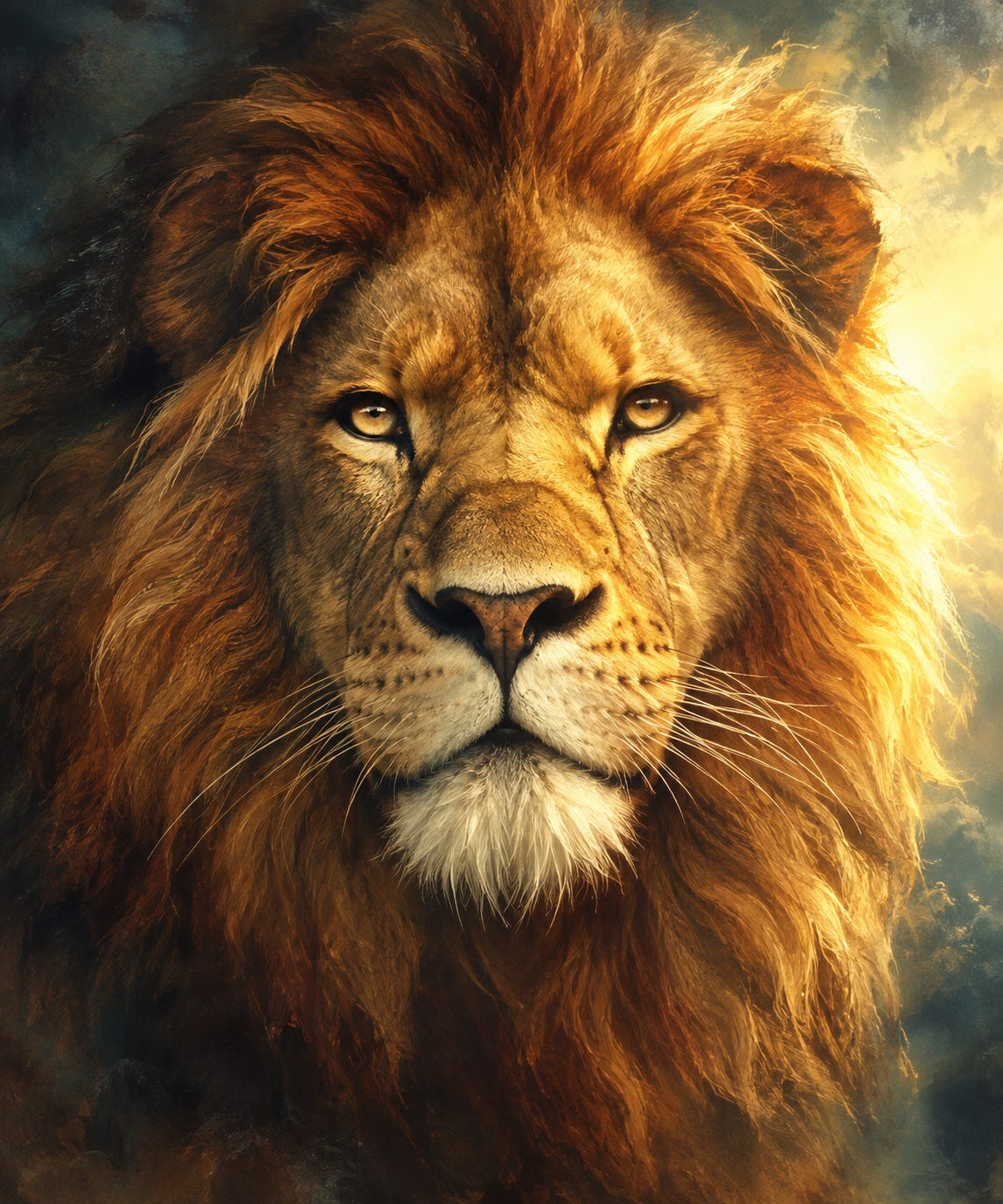
Recent news outlets have announced that the forthcoming Greta Gerwig film, a cinematic portrayal of C. S. Lewis’s The Magician’s Nephew, features the actress Meryl Streep as the voice of Aslan. At the risk of seeming dramatic, I was heartbroken. The Magician’s Nephew is one of my favorite books, and the character of Aslan has been chiseled into the Western world’s “social imaginary” (to use Charles Taylor’s phrase) for almost three quarters of a century. So, why is it such a big deal that Aslan’s voice is cast by a woman rather than a man?
For starters, I’m not conflict mongering, hoping to stir the pot of debate on gender relations. I have nothing against Meryl Streep and promote the full equality of men and women as image bearers of God. Men and women are fully equal. However, as Madeleine L’Engle once wrote in A Wrinkle in Time, “Like and equal are not the same thing at all!” Men and women can be equal without being exactly alike (i.e., interchangeable). There is an authorial reason that Aslan is portrayed as a male figure, and it parallels the authorial reason that Scripture portrays God as “Father.” It’s not just language; it’s revelatory truth written by the hand of an author. And that’s what is under attack in casting Aslan with a woman’s voice.
There is an authorial reason that Aslan is portrayed as a male figure, and it parallels the authorial reason that Scripture portrays God as “Father.”
Let me first set out why this move runs counter to Lewis’s own work. Then I’ll connect that to the biblical teaching of God as “Father” and Christ as a male, a teaching to which Lewis was clearly alluding throughout the Narnia saga.
The Literary Inaccuracy
In The Chronicles of Narnia, Aslan is called “the son of the great Emperor-beyond-the-Sea,” “the King of the Wood,” “the King of Beasts,” and “High King above all kings.” And he is only ever referenced with masculine pronouns. No one can argue that Lewis had any intentions or inclinations about portraying Aslan as a female figure. (I don’t think anyone is arguing this. Instead, they’re arguing that changing the gender of a character is a possible decision of poetic license.)
This has literary importance when it comes to allusion, the practice of referencing events and persons outside a given story, and allegory, a symbolic narrative. Aslan is obviously a Christ figure, the Lord and “the Lamb” (Voyage of the Dawn Treader) who sacrifices himself for the atonement and redemption of the world (The Lion, the Witch, and the Wardrobe). The allegory is blatant. Readers even consider J. R. R. Tolkien’s words about allegory to be a soft criticism of Lewis’s work on this point when he says, “I cordially dislike allegory in all its manifestations” (Foreword to the second edition of The Lord of the Rings). No one can respectably argue that Lewis wasn’t thinking of or influenced by Jesus Christ in his depiction of Aslan. If anything, readers admit it’s too obvious.
Based on Lewis’s language and the widespread acknowledgement of Christian allusions or allegorical threads in his writing, Lewis intended Aslan to be seen and treated as a male. That is the story he wrote. That’s not a slight against women by any means; it’s simply a reflection of the story he told. It would be equally wrong to portray Hermione Granger from Harry Potter as a boy. That’s not the story Rowling wrote. Casting Aslan with a female voice is thus a major distortion of Lewis’s work.
God as Father and Christ as Male
The decision to cast Aslan with a female voice ties into long held debates about the “gender” of God. Why should we call God “Father” rather than “Mother”? And while we’re on the topic, don’t we have the freedom to portray Jesus as female, as Cynthia Erivo does in Jesus Christ Superstar (2025)? Let me deal separately with God as Father and Jesus Christ as male.
God as Father
Why is it not okay to talk about God as “Mother”? This has nothing to do with the beautiful, holy, and amazing calling of motherhood. It has everything to do with God’s authorial choice. God, as the divine Author of the world and its redemption (Gen. 1:1; Heb. 5:9), has chosen to reveal himself with specific language, and that choice was not accidental. The words av/abba (Hebrew) and patēr (Greek) are common terms for God throughout the Bible.
Why did God choose to reveal himself this way? In God’s story, “Father” signals God’s creative, authoritative initiative in providing his children with protection, care, grace, and a glorious inheritance. Herman Bavink speaks of God as the Begetter, Creator, Sustainer, Maker, Chooser, Caller, Lover, and Parent of his people (Wonderful Works of God, 35).
But I can sense the response: “Couldn’t all of those roles fit a feminine figure—especially creator, lover, and parent?” While I’m tempted to explain God’s rationale for him, I won’t. It’s not my place as a creature to claim editorial or explanatory rights over God’s living manuscript. Who am I to question or explain God’s Authorship (Rom. 9:20)? It is not my task as a creature to validate God’s reasons and suggest different terms, any more than it’s the task of a kindergartener to validate his teacher’s lesson plans. God’s choice of this language was his choice to make, not ours. And given that God is love (1 John 4:8), we can be sure that his decision was motivated by love and not by demeaning prejudice.
Christ as male
Why is Christ a male? Christ is depicted in Scripture not only as the Son of God, but also as a husband. The character of a husband is discussed throughout Scripture, but it’s crystalized in Ephesians 5:25 with a singular calling: “Husbands, love your wives, as Christ loved the church and gave himself up for her.” The God-given, God-honoring role of a husband is self-sacrifice. And that is precisely what Christ came to do for us, his bride. The call to self-sacrifice, to be “crucified,” out of love for a bride is a distinctly male calling given to husbands. Popular debates often overlook this. They talk about men as leaders, authority figures, and heads of the household. Certainly, there’s biblical precedent and teaching on all of that (1 Cor. 11:3; Eph. 5:22–23; 1 Tim. 3:4–5). But when Paul is talking about the distinctly “husbandlike” thing to do, he emphasizes loving self-sacrifice. And the climactic expression of that is Christ being crucified for his bride, the church. That is the story God tells with his Son.
In short, God has chosen to reveal himself as Father, and Christ has come to us as a male, ultimately because the divine Author has chosen to write the story that way. And given who the Author is, that’s not just acceptable; it is good. God displays Fatherly characteristics in Scripture and in his work in our lives for his own good purposes (Matt. 11:25–26). The language and the roles in the divine story are chosen and expressed with perfect and painstaking precision for our good.
To treat the masculine language and expressions in Scripture as interchangeable with feminine language and expressions is to take God’s pen from his hand and change the story. It is to follow the serpent in Genesis 3 and ask, “Did God really write . . . ?” This is neither loving nor good. It is a challenge to the Author’s meaningful and intentional choices.
Why Cast Streep as Aslan’s Voice?
Let’s go back to Aslan. There are dozens of talented male voice actors that could have taken this role. From a strictly aural perspective, the auditory weight could be carried by an Ian McLellan or Mel Gibson—a male with a low octave range and earnest sincerity. So, why choose a woman to be Aslan’s voice?
There are times when lines get crossed, and silence would be more mercenary than merciful. This is one of those times.
The decision is not pragmatic or by happenstance. It’s a cultural move to show the interchangeability of men and women, that “like” and “equal” are the same thing, that what a man does can and should be done by a woman, too. More importantly, it’s an assault on authorship, a pulling of the pen.
It Is Written
I’m not a fire-stoker. In general, I shy away from polemical debates because my heart is sickened by conflict. But there are times when lines get crossed, and silence would be more mercenary than merciful. This is one of those times.
The decisions an author makes matter. It’s true for Lewis. It’s truer for the Author of creation and redemption. There is a reason that, throughout the Old and New Testaments, the central support for the truth and power of God’s story is simply the phrase gegraptai, “it is written.” Why is Aslan a male, and why is God a Father? Because it is written. And none of us is a qualified editor who can change that.
What Streep is doing by taking on the role of Aslan is rewriting a story. It’s not the story Lewis wrote, and it’s not the story people love. It is, regrettably, an artistic form of “Did God really say . . . ?” (Gen. 3:1). The result will not just disappoint; it will mislead. And that’s where my heartbreak comes from. Lewis was leading people to the wonder and wild joy of God. I don’t know where Greta Gerwig and Meryl Streep are leading us, but it’s not there.
P.S. You might also enjoy “The Magic Is Real”
Thank you for writing this piece. I think Greta definitely has an agenda; https://acgleason.substack.com/p/how-greta-gerwig-turned-me-into-a?utm_source=share&utm_medium=android&r=n0gfy
I appreciate the concern for authorial intention, but I think the argument makes two questionable leaps: from Aslan’s maleness to a theological necessity, and from divine fatherhood to the exclusion of feminine imagery.
It matters that Aslan is male because Lewis wrote him so. But it doesn't track that a woman VA constitutes a distortion of Lewis comparable to changing Aslan's gender. The relevant question of an adaptation is what an alteration communicates, not whether every production element reproduces the source text literally.
More importantly, Scripture itself complicates the essay's assumption that divine or Christological imagery must be confined to masculine embodiment.
Consider the Shulamite. The Song of Songs places covenantal love in the mouth of the woman as well as the man. She speaks, seeks, desires, suffers, chooses, and refuses commodification.
“My beloved is mine, and I am his” (Song 2:16) is reciprocal covenant language
Her love cannot be purchased: “If a man offered for love all the wealth of his house, he would be utterly despised” (8:7)
The Shulamite's self-emptying (“my own vineyard I have not kept” (1:6)) can be read alongside Christ's kenosis (Phil. 2:6–8)
Her fierce love “as strong as death” (Song 8:6) anticipates the divine love revealed in the crucifixion and resurrection
Read canonically, this indestructible imagery becomes remarkably suggestive as a foreshadowing/shadow-type-level typology of Christ. If Scripture can foreshadow Christ through a woman, then feminine imagery isn't necessarily theologically incompatible with Christ just because the incarnate Christ was male.
God also speaks through maternal imagery:
“As a mother comforts her child, so I will comfort you” (Isa. 66:13)
“Can a woman forget her nursing child?” (Isa. 49:15)
Wisdom, otherwise an agent of God, is personified as feminine (Prov. 8)
Mind you, that does not prove that Aslan should be female. Lewis' choice for Aslan (Jesus isekaied as lion, as we know) as male deserves respect, but it does show why the theological argument should stop short of claiming that feminine embodiment constitutes an assault on divine authorship.
So criticize Gerwig's take if it fails to understand what Lewis' male Aslan signifies or Streep doesn't perform well or the work falls apart in other departments, but to turn a woman's voice into “Did God really say?” goes way beyond what the biblical evidence warrants.
Scripture is not threatened by this inversion. Our theology should not be, either.
P. S. the idea of God as physically Woman reminds me of The Shack.